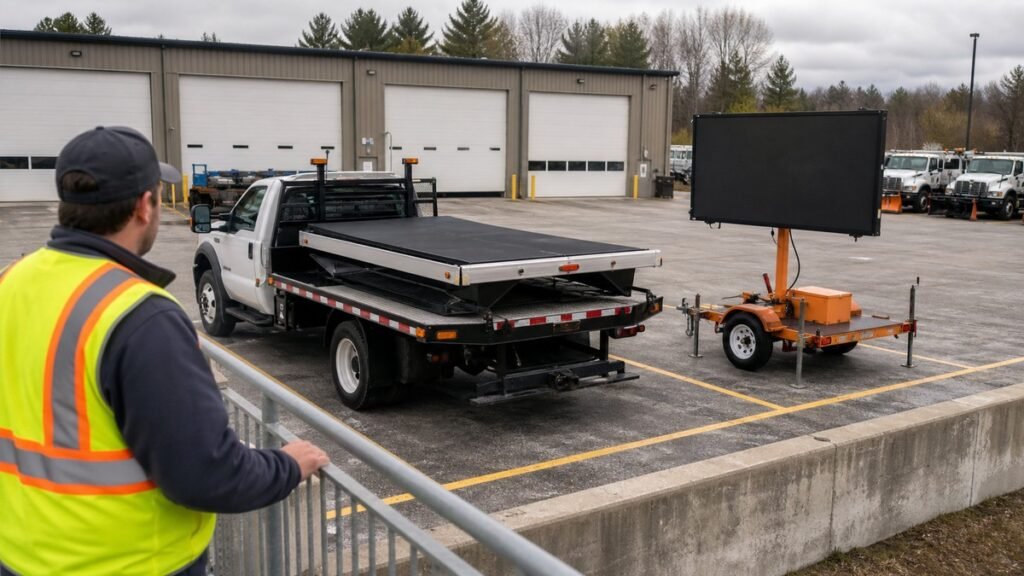
A mounted versus trailer message board decision should compare transport, storage, power, controls, configuration management, maintenance, and project acceptance—not declare one format universally better. Mounted boards keep the display tied to a vehicle configuration; trailer boards create a separate towable asset. The approved traffic-control plan, message authority, manufacturer instructions, site conditions, contracting requirements, and agency having jurisdiction still govern whether and how either product may be used.
Separate the display decision from the traffic-control decision
First define what the buyer is selecting: an equipment format and fleet support model. The project traffic-control lead sets board position, orientation, messages, lane treatment, and operating duration from the governing documents. Equipment selection supplies product facts for that project decision. Capture display capabilities requested by the owner, anticipated project environments, mobility expectations, and agency or contract submittals without promising acceptance. Record whether the board must remain with a particular truck or circulate as an independent asset. Identify the message approver and location of the approved message library. This boundary avoids a common procurement error: purchasing a feature-rich board and assuming it answers operational questions that belong to the plan. The project traffic-control reviewer confirms whether the selected format and model fit the intended application.
Compare movement and dispatch as complete workflows
A vehicle-mounted board travels with its host truck, which can simplify asset pairing but makes availability dependent on that vehicle and its full configuration. A trailer board can be assigned separately, yet it introduces towing compatibility, hitch and electrical interfaces, trailer documentation, storage, retrieval, security, and a compatible tow vehicle cleared by fleet maintenance. Map each workflow from yard release through return without writing field-placement instructions. Include who verifies asset identity, transport readiness, configuration status, required records, and project assignment. Examine schedule conflicts: a mounted board may be unavailable because the host truck is in maintenance, while a trailer may sit ready but lack a tow asset cleared for that trailer. Use the organization’s actual travel and setup records as planning inputs. The better format is the one the fleet can control consistently under its actual dispatch system and project obligations.
Review power, controls, and information security
Mounted and trailer products may use different power sources, charging arrangements, control interfaces, communications, and diagnostic methods. Compare runtime and reliability evidence for the exact products using current manufacturer documentation and fleet history. Ask how the fleet verifies charge state, protects wiring, manages batteries, controls access, records software or firmware configuration, and prevents unauthorized message changes. Remote communications can improve visibility for the designated operator, but they also create account, credential, connectivity, and change-log responsibilities. Establish who can create, approve, activate, and audit messages under the applicable project and agency process. A sales feature labeled remote control is not permission to change a display. Require a clear fallback and escalation path if communications or power status becomes uncertain, and keep that path aligned with employer procedures and project authority.
Model storage, inspection, and maintenance capacity
A mounted board occupies space and capacity on its host vehicle and may affect access to other body features. A trailer board needs its own protected parking position, maneuvering plan within the yard, tire and running-gear attention, coupling-related records, and security control. Both need product-specific inspection and maintenance based on manufacturer guidance, applicable requirements, and fleet procedures. Compare who owns routine checks, where defects are reported, which parts and tools are supported, and how a restricted board is removed from dispatch. Review safe shop access with equipment in its stored condition. Build the maintenance estimate from the exact board, power system, platform, and service schedule. The relevant measure is whether the organization can keep the selected product, its power system, controls, structural interfaces, and transport platform within documented condition through the expected duty cycle.
Compare total ownership with matched commercial scopes
Request proposals that identify the exact model, included controls, mounting or trailer platform, power equipment, delivery documents, training scope, warranty terms, optional communications, and excluded work. Add buyer-side costs for a host vehicle or compatible tow assets, storage, registration where applicable, insurance, inspections, maintenance, batteries, communications service, security, and staff administration using verified local figures. Mounted equipment may consolidate assets but commit the board to the host vehicle. Trailer equipment may expand assignment choices while adding another serialized asset to manage. Neither result creates an automatic financial advantage. Test several demand scenarios and record every utilization assumption. Clarify ownership of installation and integration work, and require appropriate review of vehicle or towing interfaces before commercial approval.
Bring the selected format through project review
Before purchase, create a short evidence package: intended applications, product data, transport model, power and control approach, storage and maintenance plan, host-vehicle or tow interfaces, document list, and unresolved conditions. Route it through procurement, fleet, maintenance, information-technology roles where remote control is involved, project traffic-control reviewers, and any required agency or contracting process. Record acceptance within each role’s scope. Western Highways Traffic Safety can supply product and integration details for its mounted and trailer CMS options, giving fleet and project reviewers comparable evidence for their decisions.
Run a tabletop logistics test before placing the order
Walk dispatch, maintenance, yard operations, project management, and information-security representatives through realistic days using each candidate format. Begin with an available asset, then add a schedule conflict, charging concern, host-vehicle defect, tow-vehicle substitution, communications outage, unauthorized access attempt, late project change, and return with an unresolved condition. For every event, ask which record changes, who acts, what source controls the decision, and how the next person sees the outcome. Include delivery between distant yards without assuming travel durations. A mounted board may keep records together yet strand the display when the host truck is held. A trailer may be present while its tow compatibility, power condition, registration, or project acceptance remains unresolved. Capture gaps as procurement requirements or process actions. The exercise tests equipment support; the project review addresses field placement separately.
Ask the vendor about product identity, controls, power, manuals, data access, service boundaries, and integration using the exact proposed model. Ask internal owners to resolve towing, vehicle, cybersecurity, contracting, and traffic-control authority questions within their roles. Where a question lacks an owner, assign one before award. Retain the completed scenarios with the decision record because they explain why a format was selected and which assumptions require confirmation during delivery. This makes later configuration or staffing changes easier to assess without pretending the original decision remains correct forever. Repeat the tabletop with the proposed delivery documents and actual asset-management fields before acceptance. This exposes missing serial identifiers, unclear responsibility for software accounts, or a storage assumption that the yard cannot support. Record the evidence that closes each gap and carry unresolved conditions into the contract. A smooth demonstration should not erase the need to test the organization’s ordinary, imperfect day.
- Asset identity and authorized configuration are visible
- Power and control ownership are assigned
- Transport and storage assumptions have evidence
- Open project-acceptance conditions remain explicit
Related resources
- Review the mounted arrow board and message board product category — ARROW BOARDS AND MESSAGE BOARDS.
- See the available trailer-mounted CMS board information — Trailer Mounted CMS Boards.
- Browse individual message board models before comparing controls and support — Message Boards.
Frequently asked questions
How should a short-term rental message board enter fleet records?
Give it a temporary controlled asset entry with exact identity, supplier documents, authorized configuration, inspection status, control access, project assignment, and return responsibility.
What belongs in a board-control handoff between departments?
Record the asset, current authorized message source, account or controller custody, operating status, open restrictions, assignment owner, and time of transfer without copying access credentials into the handoff.
How should remote-control access be retired when a board leaves the fleet?
Follow the organization’s security process to remove accounts, tokens, devices, and integrations, preserve the required audit record, and confirm responsibility with the supplier when its platform is involved.
Can remote control replace an on-site status check?
Remote information has product and connectivity limits. The fleet should define verification and escalation using manufacturer guidance and project procedures.
Should both formats appear in one procurement request?
They can, if proposals use matched capability, documentation, support, and commercial assumptions so reviewers can make a meaningful comparison.
Take the next step with Western Highways Traffic Safety
Fleet buyers comparing mounted and trailer board formats can start with a Request Quote.