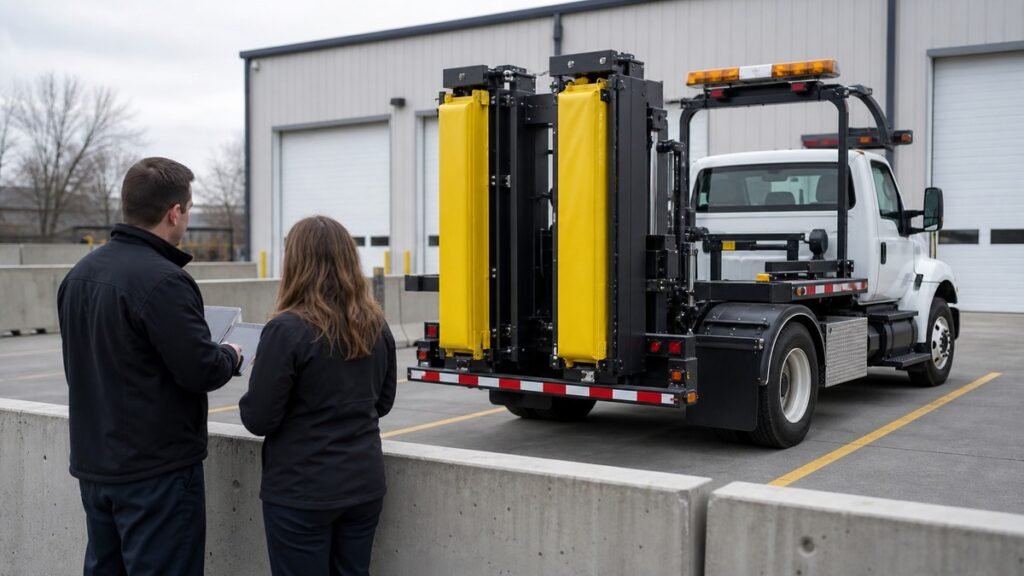
A TMA truck repair intake package should identify the exact vehicle and attenuator, describe observable symptoms, preserve incident and configuration context, list current restrictions, attach relevant manuals and prior work, and state the decision the fleet needs. Complete information helps a repair provider define scope, but it does not authorize travel, establish crashworthiness, approve field use, or replace the manufacturer’s post-event and inspection requirements.
Secure status and route the truck under fleet authority
Before arranging service, follow the employer’s process for restricting, isolating, moving, or transporting the unit. The intake document should record its current status and the person who set it. The fleet transport lead decides movement from the product instructions, vehicle condition, and incident procedure. Manufacturer instructions, evaluation by the relevant manufacturer, engineer, or maintenance lead, fleet procedures, law, and incident requirements may control. If an impact occurred, preserve evidence and initiate the appropriate reporting process before parts are disturbed, subject to emergency and safety priorities. Tell the repair provider how the truck will arrive and identify any known handling restriction without asking the provider to infer transport authorization. A clear starting status protects everyone from treating an appointment confirmation as permission to operate the vehicle.
Identify the chassis, attenuator, mount, and related systems
Provide fleet and vehicle identifiers, chassis information, attenuator manufacturer and model, serial or asset identifiers used by the owner, mount or support configuration, relevant controls, and associated lighting or board systems that may interact with the symptom. Use photographs of product labels and configuration where permitted, ensuring each image is dated and tied to the unit. Note recent configuration changes, transferred components, and buyer-supplied accessories. Avoid generic labels such as Scorpion issue when several versions or installations may exist. Include current manuals and manufacturer bulletins available to the owner, but send complete current documents with their revision identifiers. Exact identity helps the service team determine whether it can support the product, what documents or parts information it needs, and which questions require the manufacturer or another specialist.
Describe symptoms as a timeline, not a diagnosis
Write what the reporter observed, when it appeared, under what non-sensitive operating context, whether it was continuous or intermittent, and what indicators or messages were present. Record actions already taken under the fleet procedure and what changed afterward. Keep cause theories in a separate field marked unverified. A statement such as hydraulic failure can send a technician down the wrong path if the only evidence is slow movement; a neutral description preserves diagnostic options. If an issue involves several systems, show their sequence. Attach fault logs or video only when collection follows company policy and the files are labeled. Use existing observations and logs; further testing belongs in the provider’s planned diagnostic process. The service provider can define a diagnostic scope after reviewing the evidence and applicable product information.
Connect incident evidence without assigning conclusions
For an impact or suspected structural event, provide the incident record identifier, date, equipment state after the event, photographs managed under company policy, and the contact responsible for investigation or insurance coordination. Keep personal data in the incident system and report only verified equipment observations to the repair provider. Preserve components and records as required by the manufacturer, owner, insurer, contract, agency, or legal process. Ask the provider what information it needs before inspection and whether its offered scope includes the affected systems. Repair intake is not a crash investigation, engineering analysis, or certification. Some questions may need the equipment manufacturer, an engineer for the affected scope, insurer, or agency. Making those boundaries explicit prevents a repair estimate from being misread as a finding about the incident or proof of future performance.
Request a written scope and closeout package
Ask the provider to state the systems it will evaluate, source procedures, exclusions, diagnostic authorization, approval path for additional work, parts traceability, expected customer decisions, and the evidence supplied at completion. Avoid requesting a blanket make compliant outcome. Applicable requirements and project acceptance involve parties beyond the shop, and no repair can guarantee protection from future impacts. Define how estimates and changes are approved, but obtain actual pricing and timing from the provider for the specific unit using the provider’s unit-specific proposal. The closeout package should identify findings, completed work, verification performed, remaining limitations, recommended follow-up within the provider’s scope, and documentation returned. The fleet’s authorized reviewer then decides operational release separately.
Choose a provider by scope fit and communication quality
Evaluate whether the provider supports the identified equipment, can explain its diagnostic and repair boundaries, uses appropriate current technical information, protects incident evidence, controls changes, and supplies usable records. Ask how manufacturer questions are escalated and which work is referred elsewhere. Technical fit comes from exact equipment support, source procedures, and the promised closeout evidence. A complete intake lets Western Highways Traffic Safety confirm whether its Repair Services support the named truck and symptom before transport is arranged.
Prepare internal reviewers for estimate decisions
Before an estimate arrives, identify who can approve diagnosis, parts, additional labor, manufacturer consultation, outside referral, transport, and return of the unit. Give those reviewers the intake package and explain which fleet demand is affected without pressuring them to waive technical questions. Require estimate revisions to identify newly discovered conditions and explain how scope, documentation, timing, and commercial terms change. If more than one provider is considered, compare the same requested scope and evidence; a low total may omit important evaluation or closeout work. Keep warranty, insurance, and incident-investigation channels visible where relevant.
Establish how removed parts, photographs, fault logs, and configuration records will be handled. Ask whether approvals are valid only in writing and where the approved scope is stored. When the provider recommends work beyond its original review, route the change through the named owner and capture the decision in the vehicle file. Operations should plan a fleet-approved alternative instead of treating project demand as evidence that a repair is sufficient. These controls make decisions faster because people know their boundaries before a costly or safety-relevant finding appears.
Index the final evidence before release review
At closeout, reconcile the final work order, parts, findings, test evidence, open limitations, and returned documents against each approved change. Send discrepancies back to the responsible reviewer before fleet release. Commercial completion, technical completion, vehicle release, and project acceptance should remain distinct states with visible owners. Provide the fleet release reviewer with one complete intake and closeout index that links every work order, finding, test, limitation, and returned document. The index should show the current revision, restricted status, decision history, and location of retained evidence. If a required document has not arrived, label it outstanding and preserve the hold or limitation defined by the fleet release process instead of assuming the commercial invoice closes it. Make the index available to each receiving shift responsible for dispatch. The finished index gives dispatch one reliable place to confirm the unit, configuration, release status, open follow-up, and source records before considering the truck for another assignment.
Related resources
- Review the listed repair service scope before arranging intake — Repair Services.
- Use the post-crash protocol resource when the request follows an impact — Post Crash Protocol.
- Confirm the truck-mounted attenuator product context for equipment identification — Truck Mounted Attenuators.
Frequently asked questions
How should repair-intake photographs and files be named?
Use the unit identifier, capture date, affected system, and a neutral sequence label. Keep unverified diagnoses out of file names and link every file to the controlled intake record.
Should an impacted attenuator be folded or moved?
Follow product-specific manufacturer instructions and the fleet’s authorized incident and transport process; do not improvise movement from general guidance.
Does repair restore the original warranty?
Warranty coverage depends on the applicable written terms, product, event, parts, and authorized service conditions. Ask for a unit-specific determination.
Should the intake identify previous providers that worked on the unit?
Include provider names, dates, and linked work records when they relate to the current condition. Report documented scope and findings rather than speculation about prior workmanship.
How should large videos or fault logs be transmitted to the provider?
Use an approved secure channel agreed with the provider, restrict access to authorized recipients, label files to the exact unit, and retain the required copy and transfer record.
Take the next step with Western Highways Traffic Safety
Fleet teams with an identified unit and documented symptom can reach the service team through Contact Us.