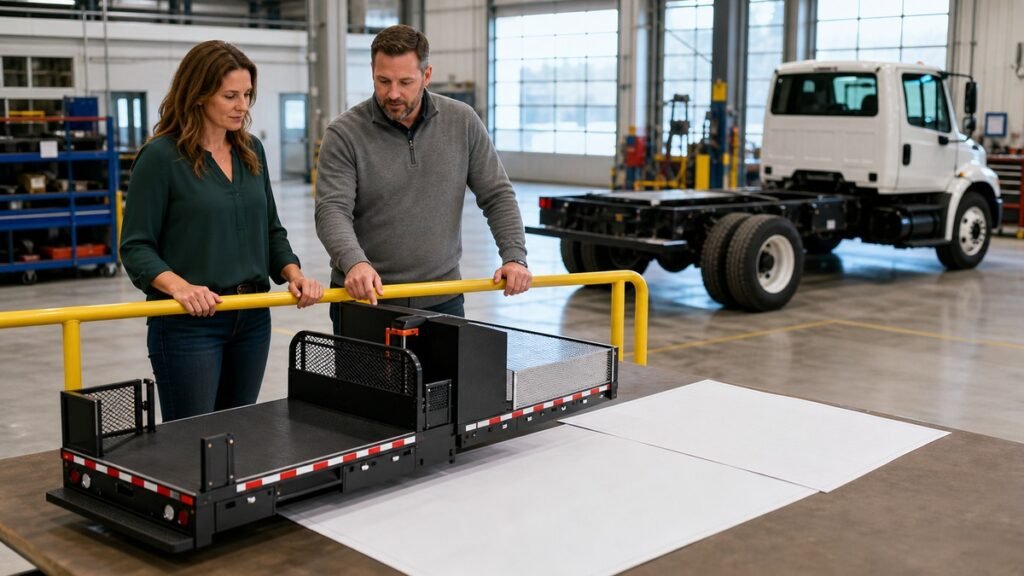
Bring a one-page operating brief, verified chassis information, a prioritized equipment and storage list, loading assumptions, access and maintenance needs, required documents, decision owners, and target milestones to a custom traffic control truck bed discovery call. The call should clarify scope and open questions. Chassis analysis, payload review, required engineering, manufacturer conditions, and project approval remain separate gates after the call.
Describe work patterns without designing the lane setup
Summarize the kinds of contracts, crews, and equipment movements the truck is expected to support. Explain whether work is mostly short-duration or extended, urban or remote, single-crew or shared-fleet, while recognizing that each project’s approved documents control field use. Describe the yard, travel, loading, unloading, inventory, and maintenance workflow where bed design has a direct relationship to the vehicle. Give the builder vehicle workflow facts; the project team retains traffic-control placement and operating-plan decisions. Identify common pain points with current assets, such as difficult inventory visibility, awkward service access, uncontrolled loose equipment, or repeated configuration changes. Rank these problems by operational importance. A concrete workflow lets the discovery team ask useful questions about storage, access, integration, and documentation without claiming a proposed layout is safe or accepted for every site.
Provide chassis and configuration facts with sources
Send information for the exact chassis being considered: identifiers, model and year, wheelbase, axle and gross ratings, available scale or curb information, frame and electrical details relevant to the proposed upfit, installed equipment, and manufacturer restrictions known to the buyer. Label preliminary values clearly. If the chassis has not been purchased, state which options remain open and who will validate them. Include photographs and drawings only when they are dated and linked to the correct vehicle. A builder needs these facts to identify interfaces and exclusions, but the presence of data in a discovery brief is not a final compatibility determination. Ask who will conduct required technical reviews and when. Avoid using a similar fleet unit as the sole source because small differences can affect mounting, power, access, loading, and documentation.
Turn the equipment wish list into prioritized load cases
List permanently installed equipment, removable attachments, signs, cones, tools, personal gear, spare parts, and other carried material. For each, provide verified quantity or realistic range, dimensions or source data where available, mass information, frequency of access, restraint needs, and whether it may coexist with other items. Separate must-have, conditional, and future items. The completed vehicle must be reviewed using accurate loading and configuration assumptions by the responsible engineer, upfitter, and fleet reviewers; payload and axle decisions require completed-vehicle and load evidence. Identify items supplied by the buyer because their interfaces still matter. If the truck may operate in several configurations, define a distinct allowed load case for each compatible mission. This gives the discovery team a basis for layout questions and exposes requirements that conflict in the proposed configuration.
Explain how people need to access and service the bed
Document who loads, inventories, inspects, cleans, and services equipment in the yard, plus the frequency and sequence of those tasks. Note requested reach, access, lighting, camera, control, and compartment needs as user requirements—not final design instructions. Include the employer’s relevant ergonomic and safety-review roles so concepts receive appropriate evaluation. Maintenance staff should identify access needed for connectors, batteries, hydraulics, fasteners, labels, drains, and replaceable components. Ask how a proposed feature is inspected and what must be removed to reach it. A compartment that looks efficient in a rendering may create service conflicts once adjacent equipment is installed. Keep field crew positioning and traffic-control procedures out of the discovery brief; those belong to the project review process. The bed conversation should concentrate on vehicle interfaces and documented yard work around the parked asset.
- Who uses each storage or access point
- Which installed systems require service clearance
- Which controls or cameras may be obstructed
Define documents, boundaries, and acceptance gates
List the evidence expected with proposals and delivery: configuration drawings, product information, manuals, installed-equipment records, weight information, inspection or test documentation, training scope, warranty terms, parts references, and as-built updates as applicable to the contract. Ask the builder to identify exclusions, buyer responsibilities, and third-party reviews. Set separate gates for concept selection, technical review, commercial release, production changes, delivery acceptance, and operational release. Name the role responsible for each. A polished drawing is not an approved design, and delivery is not authorization for deployment. If agency, contract, manufacturer, or engineering review is required, put that dependency on the decision log. This prevents a late discovery that an important interface or document was assumed to belong to someone else.
Use the call to create an action register
End the meeting with decisions, unanswered questions, responsible owners, source documents needed, and the revision that will be used for the next conversation. Confirm terminology so truck class, attachment, board, rack, body, and service scope mean the same thing to every participant. Request alternatives where a requirement conflicts with capacity, access, or another interface and record the evidence and owner for the resulting trade-off. Leave the call with one agreed revision, evidence owners, and the next review date. Circulate the action register promptly so the chassis dealer, buyer, upfitter, maintenance lead, and technical reviewers can correct misunderstandings while the discussion is fresh. Record each correction as a revision, preserving the original question and the evidence that changed the proposed response.
Create one row for every important need and columns for source, priority, affected configuration, proposed response, evidence required, owner, and status. Keep requirements measurable without inventing design values: identify the item that must be stored, the maintenance point that must remain accessible, or the document that must be delivered. Mark preferences separately beneath chassis and manufacturer limits. Link each concept revision to the matrix and explain which needs changed, moved, or remain open. A graphic can help people understand layout, but the matrix preserves the reason behind it.
Use the matrix to challenge combinations that look attractive in isolation. Additional storage may compete with access, payload, dimensions, controls, or another installed system. A future accessory provision may affect wiring and mounting now. Ask responsible technical reviewers to define the evidence they require; treat an informal sales confirmation as a product discussion, not technical acceptance. When the proposed scope leaves a conflict, document the trade-off and the person assigned to decide it. Send the updated matrix after the call so procurement proposals are based on the same versioned brief. Before accepting a concept, trace several representative items from storage through inspection, access, removal, return, and maintenance while the truck remains in the design review. Note collisions among doors, racks, controls, cameras, and service points. The exercise is not a field method; it helps reviewers identify questions that a static view can hide. Put every unresolved conflict back into the matrix with a named owner. Western Highways Traffic Safety can use the documented chassis, load list, and access matrix to frame a scoped custom-bed or engineered-upfit conversation.
Related resources
- Review custom truck bed options before defining discovery priorities — CUSTOM TRUCK BEDS.
- Explore engineered upfit capabilities relevant to interface discussions — Engineered Upfit.
- Use a representative traffic control truck class page to organize product questions — Class 5 Traffic Control Truck.
Frequently asked questions
Who should attend the first truck-bed discovery call?
Include people who can explain operations, maintenance, procurement, chassis facts, and documentation needs. Bring qualified technical or safety reviewers when their early input can prevent unsupported assumptions.
Should an existing fleet truck be available as a reference?
It can reveal workflow problems and useful features, but label differences and known shortcomings. The existing build should inform questions, not become an unverified template for the new chassis.
How should proprietary equipment information be handled during discovery?
Agree on authorized recipients and a secure exchange method before sharing it. Identify the exact revision and preserve enough controlled evidence for responsible interface review.
Will a discovery call produce a final price?
It may support a scoped proposal, but unresolved chassis facts, options, reviews, commercial terms, and changes can affect pricing.
What if a separate dealer is ordering the chassis?
Name a buyer-side coordinator, establish a controlled exchange among the dealer and upfitter, and require written notice of option or delivery changes. Neither supplier should assume the other received an update.
Take the next step with Western Highways Traffic Safety
Teams with a chassis and prioritized operating brief can begin with a Request Quote.