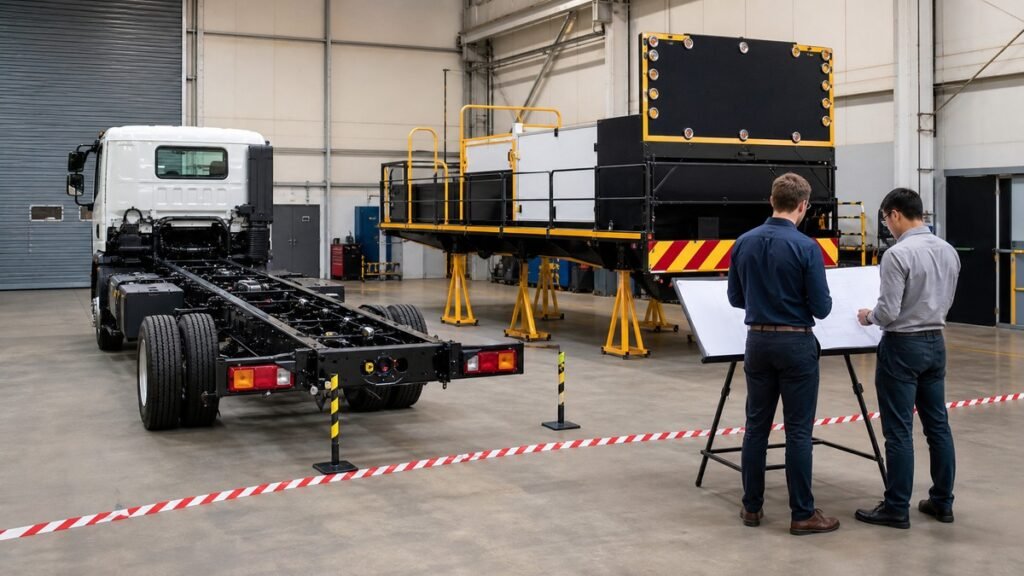
A traffic control truck compatibility file gathers the verified chassis, body, attachment, electrical, payload, dimensional, and service assumptions that must agree before a purchase is released. It is not an engineering approval or a promise that a proposed configuration is suitable. Its purpose is to give the buyer, upfitter, manufacturer, fleet maintainer, and any required qualified reviewers one controlled set of questions, evidence, owners, and unresolved decisions.
Start with the operating need, not a preferred component
Describe the work the fleet expects the vehicle to support without prescribing field placement or promising one configuration will cover every project. Capture typical duty cycle, travel conditions, storage needs, towing or attachment expectations, crew access concerns, maintenance environment, and jurisdictional variation. Identify which facts are firm contract requirements and which are planning assumptions. A request such as add an attenuator and board is too thin because it does not reveal the chassis constraints, equipment interfaces, or approval path. Ask the project and safety teams to identify controlling documents and the roles that must accept the final configuration. If multiple applications are expected, list them separately; conflicting needs are easier to see when they are not averaged into a generic use case. The file should explain why the asset is being considered and what evidence will determine fit. That gives vendors a responsible basis for questions without asking them to invent the buyer’s operating criteria.
Build a verified chassis fact sheet
Use source documents tied to the exact vehicle, not a similar model found online. Record the chassis identifier, model year, configuration, wheelbase, axle ratings, gross ratings, curb or scale information available to the buyer, frame details relevant to the proposed work, power takeoff or auxiliary-power provisions, electrical architecture, braking interfaces, suspension information, and manufacturer restrictions. Mark every value with its source and revision date. Separate measured conditions from published specifications and note who performed any measurement. Payload review must account for the completed vehicle, permanently installed systems, fluids, occupants, tools, signs, cones, and other carried material under the buyer’s actual loading assumptions. A compatibility file does not calculate or certify final capacity on its own. It gives the chassis manufacturer, upfitter, qualified designer or engineer where required, and fleet owner a common factual baseline for their respective determinations.
Map each interface before price becomes the deciding factor
Create an interface register covering physical mounting, frame modifications, center-of-gravity assumptions, electrical demand, lighting and controls, hydraulics if present, camera sight lines, access points, storage clearances, attachment geometry, labeling, and service access. For each interface, name the responsible party and the document that will close it. An accessory may fit dimensionally yet conflict with wiring protection, inspection access, body movement, or another installed system. Likewise, a component offered for a truck class is not automatically appropriate for every chassis within that class. Ask vendors to identify prerequisites and exclusions in writing. Keep open items visible rather than converting them into optimistic notes. When a product has manufacturer installation instructions or a required mounting arrangement, reference the current controlled document. Any deviation should follow the appropriate technical review and written authorization process; a sales conversation is not a substitute for that evaluation.
Control changes across drawings, quotes, and approvals
Compatibility can be lost after an early review if a body dimension, equipment model, chassis option, storage layout, or electrical package changes. Give the file a revision number and maintain a decision log that ties each change to affected drawings, calculations, quotes, and reviewer actions. Highlight substitutions instead of treating them as equivalent. Require a renewed interface check whenever a change affects mass, dimensions, mounting, power demand, visibility, controls, access, or manufacturer conditions. Quotes should state their configuration basis and exclusions so commercial approval does not accidentally authorize an unresolved technical variation. Record buyer-supplied equipment with the same discipline as upfitter-supplied equipment. Before release, hold a cross-functional review in which procurement, operations, maintenance, the upfitter, and required technical authorities see the same revision. A clean signoff page should show scope-specific acceptance, not one broad signature that appears to certify matters outside a person’s role.
Plan the evidence needed at delivery
Define the delivery package while the configuration is still being developed. Depending on the purchase and applicable requirements, it may include as-built information, installed-equipment identifiers, manuals, warranty terms, inspection or test records, training materials, parts references, weight documentation, maintenance requirements, and a list of approved deviations. The exact package is contract- and product-specific; do not assume every item is supplied unless it is written into the agreement. Establish how discrepancies will be recorded and who can accept or reject them. Delivery review should compare the physical truck with the controlled configuration, not merely confirm that a vehicle arrived. Operational release is a separate fleet decision that may require training, registration, inspections, project review, or other steps. Keeping commercial receipt, technical acceptance, and operational release distinct prevents a signed delivery ticket from being misunderstood as proof of suitability.
Use the file as the beginning of lifecycle control
Archive the accepted compatibility file with the vehicle record and connect it to maintenance, parts, attachment changes, and future resale decisions. Mechanics need to know which installed systems and interfaces were approved; procurement needs the original assumptions when ordering replacements; operations needs the documented limits and required source materials. When equipment is moved to another chassis, begin a new compatibility evaluation rather than copying the prior approval. Periodically review whether the truck’s actual load, duty cycle, or accessories have drifted from the purchase basis. A disciplined file makes those decisions visible and reviewable instead of burying them inside disconnected emails and quote revisions.
Keep an assumption register beside the interface list. Each entry should state the unverified fact, why it matters, evidence needed, owner, and decision date. Examples may include buyer-provided weights, future attachments, electrical reserve, storage quantities, or a chassis option not yet ordered. Do not let an assumption migrate into a drawing title, proposal, or purchase order as though confirmed. If evidence cannot be obtained in time, preserve the condition in the commercial record and explain the change process.
Before production release, read the quote, drawings, chassis facts, option list, and assumption register together. Look for identical terms used differently, equipment referenced without a model, and responsibilities described as by others without naming the party. Confirm that the configuration under technical review is the one being purchased. This comparison keeps commercial urgency from closing technically open questions and creates a useful record if a change appears later. Assign a final coordinator to verify that every conditional entry either has evidence, remains an explicit commercial condition, or has been removed by an authorized decision. The coordinator should not approve technical matters outside that role; the task is to make missing ownership visible. Archive the reviewed register with the accepted configuration so future maintenance and modifications begin from confirmed facts rather than reconstructed assumptions. Western Highways Traffic Safety can review the proposed chassis and product scope against the upfit information needed for a Request Quote.
Related resources
- Explore the available engineered upfit scope for configuration discussions — Engineered Upfit.
- Review custom truck bed options that may shape interface questions — CUSTOM TRUCK BEDS.
- Use the existing build checklist to organize storage and crew readiness needs — Traffic Control Truck Build Checklist for Storage, Sign Handling, and Crew Readiness.
Frequently asked questions
Can one compatibility file cover several identical trucks?
A controlled master may support repeated builds, but each chassis and completed unit still needs identity-specific records, deviations, delivery evidence, and release decisions.
How should confidential chassis drawings be shared with reviewers?
Use the buyer’s approved access-controlled system, identify the drawing revision, and limit distribution to authorized participants while keeping evidence that required reviewers received the correct version.
Who owns an interface question that spans two equipment suppliers?
The buyer should assign one coordinator to obtain written input from both suppliers and route the combined issue to the appropriate technical reviewer; neither supplier should assume the other resolved it.
Should rejected configuration alternatives remain in the file?
Keep a concise decision record when an alternative explains an important constraint or prevents it from being proposed again. Mark it rejected so it cannot be mistaken for accepted scope.
What if a source document is superseded before delivery?
Identify the affected interfaces and ask the responsible manufacturer and qualified reviewers whether the new revision changes prior conclusions, required evidence, or commercial scope before acceptance.
Take the next step with Western Highways Traffic Safety
Procurement teams comparing chassis and upfit details can prepare the information needed for a Request Quote.