
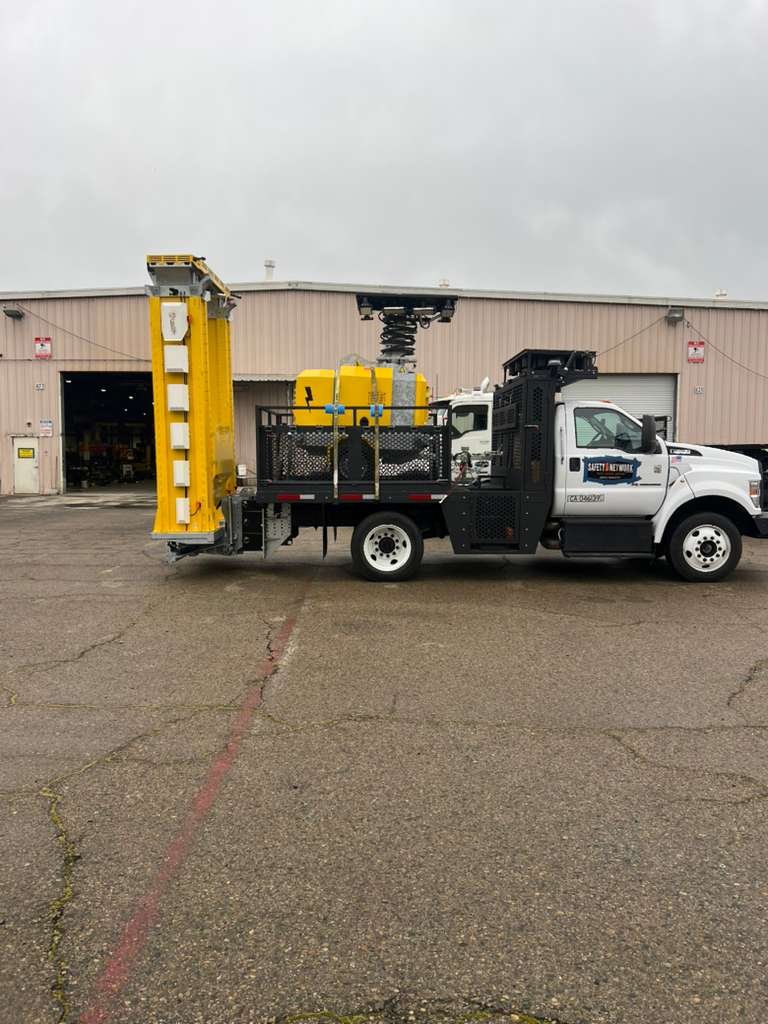
Choosing a traffic safety truck is rarely about the truck alone. For 2026 work-zone planning, buyers need to line up the chassis, attenuator, visibility equipment, storage, serviceability, and deployment method before the first truck rolls out. A used International MV may fit a municipal or contractor fleet well; an older 2014 International 4300 or 2010 International 4300 may also be practical if the maintenance record is solid and the upfit is still appropriate for current field demands.
The fastest way to avoid a costly mismatch is to compare the vehicle and the job together. Start with the route, lane closure pattern, and crew size, then decide whether you need a TMA truck, an attenuator truck, a support vehicle with arrow boards and message boards, or a full custom build with traffic sign storage racks and fleet storage features. If you are weighing a rental, lease, purchase, or custom build, Western Highways Traffic Safety Products can help you sort through the details from Fresno, California, and the satellite facility in Justin, Texas.
What to decide first
Before comparing units, define the job in plain terms. The right answer for a freeway maintenance crew is not always the right answer for a striping contractor, utility team, or public works department. A truck used for high-speed lane protection has different needs than a truck used for day-shift traffic control, short-duration closures, or mobile maintenance.
- Exposure speed: urban arterial, state route, freeway, or shoulder work.
- Duration: one-night closures, recurring maintenance, emergency response, or long-term projects.
- Crew workflow: do workers need the vehicle to carry cones, signs, stands, lighting, and spare parts?
- Travel distance: local routes, regional service, or statewide deployment.
- Ownership model: rental, lease, purchase, or a dedicated custom truck build.
These five choices affect everything else. They determine whether the most important feature is the attenuator, the bed layout, the cab configuration, the fuel tank size, or the ease of maintenance.
Older International chassis: where they still make sense
Many fleets look at used International trucks because the platform is familiar, parts support can be manageable, and the chassis has a long service history in commercial work. That said, older units should be judged as work assets, not just model years.
2010 International 4300 and 2014 International 4300
The 2010 International 4300 and 2014 International 4300 often come up in used fleet planning because they can be adaptable for traffic control or attenuator upfits. A buyer should check the remaining chassis life, rust, frame condition, electrical integrity, cab wear, and whether previous modifications were done cleanly. If the truck has already served in work-zone duty, inspect hard for fatigue around mounts, wiring, bed tie-ins, and rear structure.
The phrase 2014 International 4300 value is only meaningful after you know the body condition, engine hours, service documentation, and whether the truck can still support the job you need. A lower acquisition price can disappear quickly if the bed is damaged, the electrical system is unreliable, or the chassis needs repair before upfitting.
International truck 2010 and 2014 International as used options
Some fleets search by shorthand such as International truck 2010 or 2014 International when they are trying to compare replacement cycles. The model year alone is not enough. For traffic safety use, a more useful checklist includes:
- frame straightness and corrosion
- transmission and driveline condition
- braking performance under load
- electrical system stability
- rear structure compatibility with the attenuator
- upfit history and repair records
- idle time, engine hours, and route type
Used chassis can work well when the original duty cycle was moderate and the maintenance logs are complete. They can also become expensive very quickly if they were overworked in stop-and-go service or patched repeatedly after impacts.
International 4300 fuel tank capacity matters more than buyers expect
International 4300 fuel tank capacity matters on long workdays and regional routes. A truck that is technically suitable on paper may still be a poor operational fit if it cannot cover a shift plus staging, backup, and return travel without interrupting the crew. That is especially important for emergency response, utility contractors, and agencies with scattered service areas.
When evaluating fuel range, ask how the truck will really be used:
- Will it sit at a fixed work zone all day?
- Will it run from yard to site to site?
- Will it tow equipment or carry extra payload?
- Will it need to idle with warning systems running?
If the answer is yes to several of those questions, fuel range should be reviewed alongside payload and axle ratings, not as an afterthought.
Truck-mounted attenuator choices: fit the system to the risk
A truck-mounted attenuator is not simply a piece of add-on equipment. It is a collision management tool that must be selected with the truck, the work zone, and the current project specifications in mind. Western Highways supplies a large West Coast inventory of attenuator solutions and supports practical deployment choices for fleets that need the right combination of safety and uptime.
Scorpion, Blade, Metro TMA, TMA Pro, and TMA Max
Buyers often compare names like Scorpion TMA, Blade TMA, Metro TMA, TMA Pro, and TMA Max. The correct fit depends on truck class, rear-end geometry, work-zone speed environment, storage needs, and how often the unit will be deployed or repositioned.
Rather than asking which attenuator is universally best, ask which one aligns with the real operating conditions:
- Does the project require a compact rear profile?
- Will the truck be used in freeway protection or local traffic control?
- How often will the attenuator be raised, lowered, or serviced?
- Will the truck also carry boards, cones, or sign material?
- Does the crew need a lighter-duty arrangement or a more robust setup?
For buyers comparing models, it helps to read a practical attenuator replacement guide before committing to a chassis or upfit. If the attenuator is the wrong size or style for the existing truck, the whole build can become awkward in the field.
MASH and TL-3 discussions belong at the start, not the end
Some procurement teams wait until the last stage to ask about MASH/TL-3 considerations. That is risky. The right level of review should happen before purchase or lease paperwork is signed. Buyers should confirm the current agency specs, manufacturer guidance, and project requirements with the appropriate authority. A truck that looks ready in the yard may still be wrong for the job if its configuration does not match the governing standard or the deployment environment.
If your team needs a broader safety review, use internal resources like a compliance-focused TMA checklist and a practical overview of how attenuators support work-zone protection.
Comparison table: how buyers usually sort the options
| Decision point | Best when | Watch-outs |
|---|---|---|
| Used International chassis | You need lower entry cost and the truck has strong records | Hidden corrosion, prior crash repairs, wiring issues, body fatigue |
| Newer chassis or custom build | You need a job-specific layout and longer service horizon | Higher initial cost, longer lead planning, spec discipline required |
| Rental | You need short-term coverage, emergency response, or bridge work during a replacement cycle | Availability, wear conditions, attachment compatibility |
| Lease | You want predictable fleet planning and less capital strain | Contract limits, mileage assumptions, end-of-term responsibilities |
| Purchase | You have steady utilization and in-house maintenance | Upfront capital and long-term repair exposure |
| Custom truck build | You need a layout tailored to signs, boards, racks, tools, and crew workflow | Specification accuracy and coordination with the upfit process |
What to inspect before buying or redeploying a truck
A traffic safety truck can look acceptable from ten feet away and still fail in daily service. A smart inspection focuses on the parts that affect safety, uptime, and ease of deployment.
- Frame and rear structure: look for corrosion, cracks, impact damage, and uneven repairs.
- Electrical system: verify warning lights, cab controls, charging system health, and accessory circuits.
- Attenuator mounts: inspect for wear, bent hardware, sloppy modifications, and missing reinforcement.
- Bed and storage layout: confirm that signs, cones, and tools can be accessed without unsafe lifting or climbing.
- Visibility equipment: test arrow boards and message boards for brightness, stability, and mounting position.
- Cab condition: check driver ergonomics, backup visibility, camera function, and control labeling.
- Service records: verify oil changes, brake work, suspension repairs, and any prior collision repairs.
- Title and documentation: ensure the truck identity matches the records and upfit paperwork.
For fleet teams that rely on older assets, our guide to evaluating a used TMA truck can help teams avoid the most common blind spots.
Storage and workflow: the hidden part of the spec
Many work-zone problems come from poor storage design, not from the attenuator itself. If a crew has to hunt for cones, climb awkwardly for signs, or shift equipment around by hand every morning, the truck will slow down operations and increase exposure.
Traffic sign storage racks and fleet storage
Traffic sign storage racks and fleet storage features should be treated as core equipment, especially for crews that carry multiple sign packages or move between sites during the day. A cleaner layout reduces manual handling and helps the truck leave the yard prepared.
Look at rack systems as part of the whole operation:
- Can the crew remove signs without blocking traffic lanes in the yard?
- Are heavy signs secured against vibration and damage?
- Is the storage position compatible with the attenuator and rear visibility?
- Does the layout support fast restocking between shifts?
For some fleets, add-ons like 3S swing racks or a Buster rack system can improve organization and reduce handling time. If the truck also supports frequent sign deployment, those details are worth more than a generic body package.
Custom truck beds for traffic control operations
When a crew carries boards, cones, barricades, lighting, and repair gear, a standard bed may not be enough. A purpose-built layout can cut dead time and reduce damage to expensive tools. See the broader planning points in the benefits of custom truck beds for traffic control operations and custom truck beds if you are building from the ground up.
Visibility equipment should support the truck, not crowd it
Warning devices are often treated as separate line items, but they should be specified alongside the truck. The right combination of arrow boards, message boards, and cab controls can help a crew set up and clear sites faster.
Arrow boards versus message boards
Arrow boards are usually chosen for direct lane guidance, while message boards are used when the crew needs to communicate more detailed instructions, closures, or detours. Many buyers need both across different job types. If you are comparing formats, a useful starting point is choosing between arrow boards and message boards and the related guide on how to choose the right message board.
Important questions include:
- Can the board be seen clearly at expected approach distances?
- Does the mount interfere with the attenuator or bed access?
- Is the control system easy for the driver to use without distraction?
- Will the board survive the vibration and weather on your route?
Rental, leasing, or purchase: which path fits the work cycle?
The decision is often less about accounting theory and more about operational rhythm. A municipality with seasonal paving, a contractor with emergency response work, and a fleet with predictable year-round deployment may each choose a different model.
- Rental: useful for surge demand, interim coverage, or a temporary project that needs immediate equipment.
- Leasing: may help spread cost over time and keep vehicles moving through a planned cycle.
- Purchase: best when utilization is high and the team can maintain the asset consistently.
- Custom build: the strongest option when the truck must perform a very specific role over many shifts.
If you are balancing short-term needs against longer-term fleet refresh plans, ask about availability of rentals, leasing, purchase options, and service support at the same time. That reduces the chance of spec drift later in the process.
What maintenance and repair support should be part of the decision
The best truck is the one that keeps working. A procurement decision should include maintenance access, repair turnaround, and support for the upfit itself. Western Highways offers service-minded support for buyers who need help after the sale, including repairs and practical fleet planning.
For fleets that operate hard and cannot afford extended downtime, review internal support options such as 24/7 equipment repair for TMA trucks and how to avoid fleet downtime. If you are evaluating an attenuator already in service, a focused repair review can be just as valuable as a replacement quote.
Questions service managers should ask
- Can the supplier support both the chassis and the attenuator side of the build?
- Are parts and service available without shipping delays that strand the truck?
- Does the supplier understand local deployment patterns in California and Texas?
- Can the layout be repaired without redesigning the whole truck?
Buyer mistakes that cause most delays
Most delays come from avoidable planning errors. The same mistakes show up in public fleets, contractor fleets, and emergency response operations.
- Buying by year only: a 2010 or 2014 International may be a bargain or a headache depending on condition.
- Ignoring body compatibility: the attenuator may fit the truck in theory but not in daily use.
- Overlooking storage: poor rack planning creates daily friction for the crew.
- Choosing visibility equipment too late: arrows and message boards should be part of the spec.
- Not verifying requirements: current agency or project specifications can override assumptions.
- Skipping service planning: a good truck without support can still leave the fleet exposed.
Best-fit summary
If you need a quick way to narrow the field, use this rule of thumb: choose the simplest truck that can safely do the job, but do not under-spec the storage, visibility, or support systems. A used International MV, 2010 International 4300, or 2014 International 4300 can be a sound platform when the structure is clean and the service history is real. A newer custom build may be the better choice when the crew needs specific racks, boards, and workflow efficiency from day one.
For high-speed protection, the attenuator decision should lead the conversation. For day-to-day traffic control, the bed layout and warning equipment may matter just as much. For agencies and contractors comparing rental, leasing, or purchase, the right answer depends on how often the truck will be on the road and how much downtime the operation can absorb.
How Western Highways can help
Western Highways Traffic Safety Products supports buyers across the West Coast and nationwide from Fresno, California, with a satellite facility in Justin, Texas. The team works with contractors, municipalities, fleets, and agencies on truck-mounted attenuators, TMA trucks, Scorpion and Blade solutions, traffic control trucks, message boards, arrow boards, storage racks, custom truck builds, rentals, leasing, and purchase options. If your project includes a used chassis, a replacement attenuator, or a full buildout, the conversation can start with the actual work pattern instead of a generic spec sheet.
For buyers comparing locations and logistics, it also helps to discuss pickup, delivery, service access, and the support needed to keep the truck in rotation. Fresno, Selma, Bridgeport, and broader West Coast routes often need different handling than a nationwide deployment plan, and the right supplier should be prepared for that reality.
What to have ready before you call
Have these details ready so the discussion stays focused:
- truck make, model, and year
- current mileage and engine hours, if known
- what the truck will do: freeway protection, utility response, paving support, or traffic control
- whether you need a rental, lease, purchase, or custom build
- preferred attenuator style, if already known
- storage needs for signs, cones, and tools
- any agency, DOT, or project requirements that must be verified
- timeline for delivery, pickup, or service
Call Western Highways Traffic Safety Products at (559) 394-7762 to talk through the best TMA truck, attenuator, sign storage, arrow board, message board, rental, leasing, purchase, or custom truck solution for your operation.
