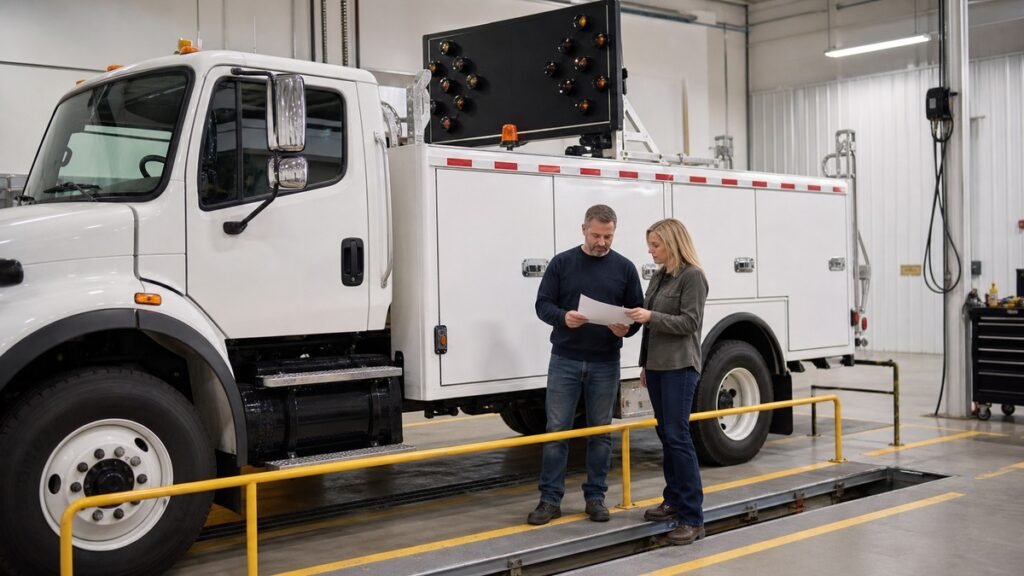
A post-repair record should connect the original symptom, inspection findings, authorized scope, parts or adjustments, supporting tests, remaining restrictions, and release decision to the exact traffic safety truck. It should never turn a repair invoice into blanket approval for field use. Reassignment then follows the fleet release process, manufacturer requirements, project documents, and any review required by the contracting agency or authority having jurisdiction.
Preserve the original condition before describing the fix
Start with the report that triggered service. Identify the unit, installed equipment, date, reporter, observable symptom, operating context, and any immediate restriction applied by the fleet. Use neutral language: describe what happened without diagnosing a cause that has not been verified. Include photographs, fault information, or damaged-part tags only when they are labeled and retained under the organization’s process. If an impact or other incident occurred, link the repair record to the separately controlled incident and post-event procedures; do not compress sensitive investigation conclusions into a mechanic’s work note. Record any configuration changes made before the truck reached the shop. A reliable before-state helps the technician reproduce the issue, prevents scope drift, and lets the release reviewer determine whether the original concern was actually addressed. It also distinguishes a newly discovered defect from the condition that initiated the repair.
Write repair scope in component-level terms
The authorized work order should name the system or component, the requested evaluation, approved corrective work, exclusions, and the party who can approve added scope. Broad directions such as repair safety equipment invite different interpretations. Separate chassis work, body or storage hardware, electrical and control systems, warning devices, board systems, and attenuator-related work because different instructions and competencies may apply. Reference current manufacturer service information and other controlled sources used by the technician. Where a condition falls outside the shop’s role, document the referral rather than implying it was evaluated. If parts are replaced, record identifiers and traceability required by the fleet or manufacturer. If an adjustment is made, identify the procedure instead of publishing an unsupported universal setting. This detail supports future maintenance without turning the article—or the work order—into field instructions that ignore product, vehicle, and jurisdictional differences.
Match verification evidence to the repaired function
A verification entry should state what was checked, under what controlled conditions, which procedure or acceptance source was used, who performed it, when it occurred, and the result. The evidence must match the repaired function. A power-on observation may confirm that a display energizes, but it does not establish every operating mode, message authorization, mounting condition, or project suitability. A stationary shop check may not address behavior under load or travel. Conversely, road or functional testing must follow the employer’s authorized safety process and applicable requirements; it should not be improvised to close paperwork. Record limitations and deferred checks explicitly. Attach test records where the procedure requires them and protect calibration or tool traceability information. The goal is not to produce the longest report. It is to prevent a narrow result from being summarized as fully compliant or ready for all work, claims that the available evidence cannot support.
Keep repair completion separate from operational release
Repair completion means the authorized shop scope is finished and documented. Operational release means the fleet’s designated authority has reviewed the relevant evidence, restrictions, configuration, and prerequisites for reassignment. Those are different decisions and may involve different people. Create separate signatures or digital states for technician completion, quality review if required, maintenance acceptance, and fleet release. Project-specific approval remains outside a generic shop release and may require the traffic-control plan owner, contractor, engineer, or agency to act within their roles. An equipment vendor or repair provider should not be presented as approving lane closures or field placement. If a unit is released with a limitation, describe the limitation precisely and ensure dispatch systems display it. Avoid conditional notes that rely on oral explanation. A truck with an unresolved safety-critical question should follow the fleet’s hold and escalation procedure until the authorized reviewer documents an outcome.
Return manuals, settings, and physical configuration to control
After repair, confirm that covers, guards, labels, connectors, retained hardware, storage restraints, and access panels affected by the work are accounted for under the relevant procedure. Update equipment identifiers and configuration records when a component or software-controlled item changes. Return current manuals and service documents to the controlled location, and mark superseded copies so they are not reused. If settings are configurable, document the authorized value and source without treating it as a universal recommendation. Check that loose tools, removed parts, and quarantined materials follow shop controls. Any temporary protection or bypass used during diagnosis must be resolved and recorded before release under the applicable procedure. This closeout work prevents the repaired symptom from receiving attention while a secondary change goes unnoticed. It also gives the next technician a reliable starting point if the condition recurs.
Use recurrence reviews to improve the system
When a condition returns, compare the before-state, repair scope, verification evidence, duty context, and later symptoms across records. Do not assume recurrence proves technician error or that repeated component replacement identifies the root cause. A qualified review may need to examine interfaces, environment, loading, installation, maintenance intervals, or operating practices within its authorized scope. Track patterns using verified fleet data and avoid announcing a failure rate from a small or inconsistent sample. The useful output is an action owner: obtain manufacturer guidance, revise a checklist, inspect related units, change a purchasing requirement, or escalate for technical analysis. With the exact unit, symptom, and requested evidence identified, Western Highways Traffic Safety can confirm whether its Repair Services fit the issue and define the records returned at closeout.
Give dispatch a release summary it can interpret correctly
Translate the controlled repair record into a concise dispatch status without deleting its conditions. Identify the unit, configuration, release authority, effective date, remaining restrictions, required follow-up, and location of the full evidence. Avoid a green indicator that hides a limitation or a note that can be truncated on a mobile screen. Test the entry with dispatchers who did not join the repair: they should know whether the vehicle can enter assignment review and whom to contact.
Define the events that reopen released status
Dispatch status is not approval for a specific work-zone setup. Tie each assignment to project authorization and required inspection processes. When follow-up becomes due, configuration changes, a symptom returns, or an incident occurs, define what reopens status. Preserve the earlier release instead of overwriting it. This translation closes the gap between sound shop documentation and the operating system that decides which assets are considered for work. Include a direct link to the controlled release record instead of copying a partial version into scheduling software. If the dispatch platform cannot display limitations clearly, establish an additional acknowledgement step under the fleet procedure. Review access permissions as well, because a status that only one shift can open will fail during a handoff even when its technical content is complete.
Related resources
- Confirm the available repair service scope before routing a vehicle — Repair Services.
- Review the separate post-crash protocol resource when an impact is involved — Post Crash Protocol.
- Use the service and inspection playbook to connect records between projects — TMA Service and Inspection Playbook for Keeping Trucks Job-Ready Between Projects.
Frequently asked questions
How should owner-furnished replacement parts be recorded?
Identify the supplier, part number, source documentation, authorization, installation record, and any warranty or traceability limits. Customer ownership does not remove the need for compatibility review.
Should replaced parts be kept after service?
Follow contract, manufacturer, warranty, investigation, and fleet retention requirements. The record should state disposition when traceability or further review matters.
Should subcontracted repair work appear in the same vehicle record?
Yes. Link the subcontractor’s defined scope, findings, parts, verification, and limitations to the primary work order so the release reviewer can see the complete chain of work.
What if repaired equipment returns without a required manual?
Record the missing document as an open closeout item, obtain the current controlled copy from an authorized source, and apply the fleet’s release rule rather than using an unverified substitute.
Where should a warranty claim number appear?
Cross-reference it in the work order, parts record, and final closeout index where relevant, without treating an open or approved claim as proof that the technical release is complete.
Take the next step with Western Highways Traffic Safety
Fleet managers who need to clarify repair support for a specific unit can reach the team through Contact Us.