Every year in the United States, hundreds of roadway workers are killed or seriously injured in work-zone crashes most often when a speeding vehicle strikes them from behind while they are performing routine tasks such as paving, striping, sweeping, surveying, flagging, or setting up signs. (Verdegro) According to the National Work Zone Safety Information Clearinghouse and FHWA data through 2025, rear-end impacts into workers or equipment account for approximately 40–45% of all work-zone fatalities and a significantly higher percentage of serious injuries.
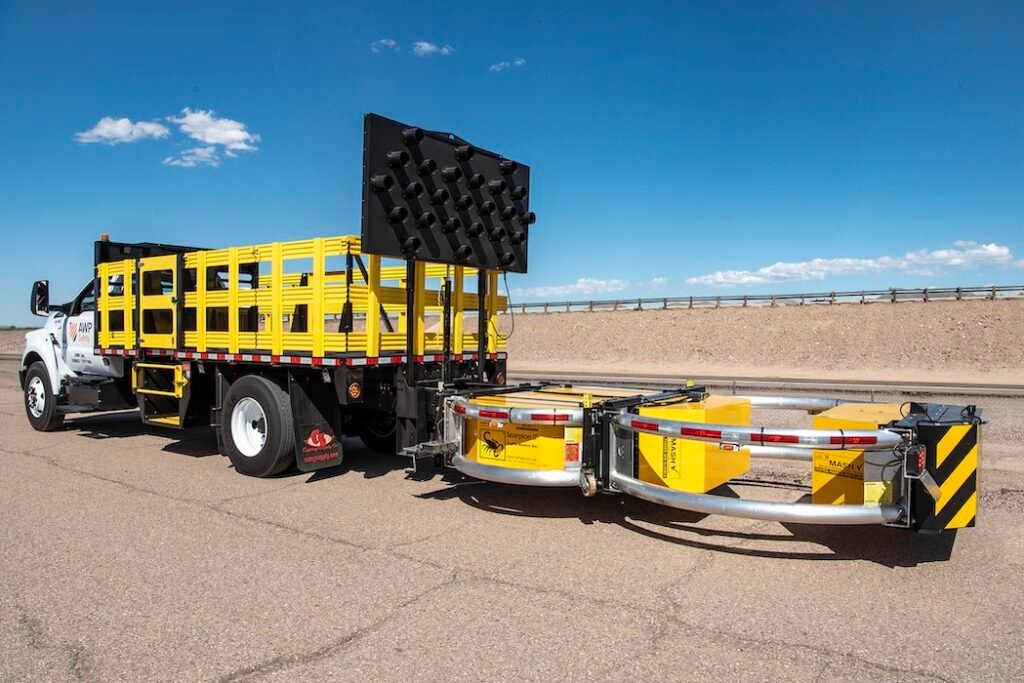
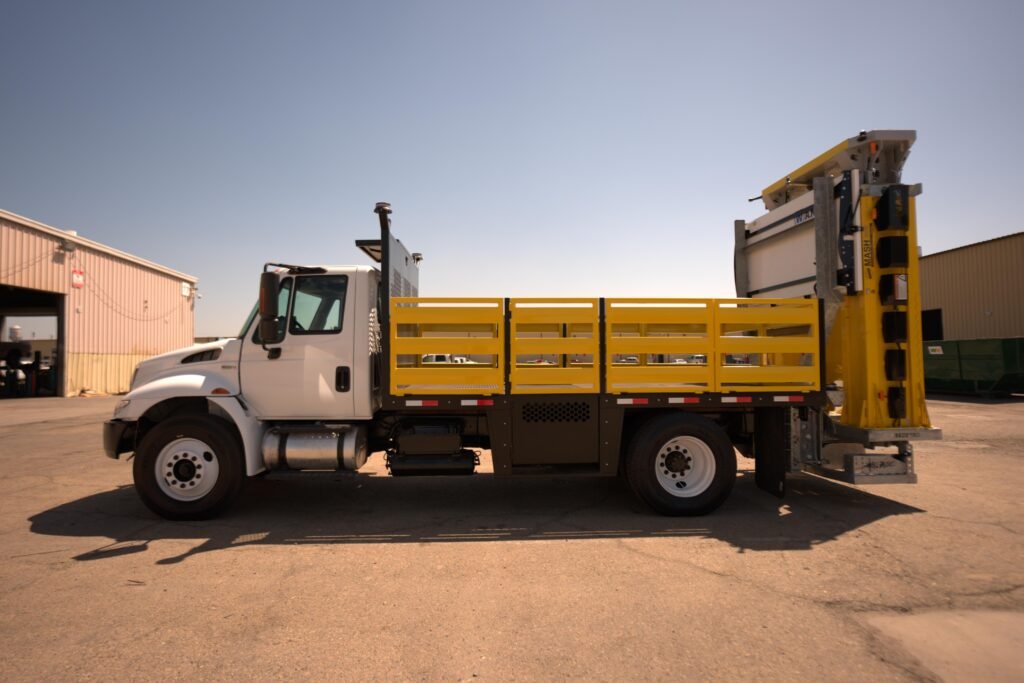
The single piece of equipment that has proven most effective at preventing these tragedies is the Truck-Mounted Attenuator (TMA) — commonly called a shadow vehicle or crash cushion truck. When properly specified, deployed, and maintained, a TMA can absorb the energy of a high-speed impact, bring the errant vehicle to a controlled stop, and protect both the workers ahead and the occupants of the striking vehicle.
Western Highways Traffic Safety has supplied, installed, and maintained MASH-certified TMAs on more than 680 vehicles operating in California since 2008. Our trucks have been struck multiple times at speeds up to 68 mph — every time the TMA performed as designed, the shadow-vehicle driver walked away uninjured, and no workers were harmed. This article explains how TMAs save lives, the key technical requirements that make them effective, and why proper selection and deployment are non-negotiable for any contractor working on or near live traffic.
The Physics: How a TMA Absorbs Deadly Energy
A vehicle traveling 70 mph carries enormous kinetic energy — approximately 450–500 kJ for a typical passenger car or pickup truck. Without mitigation, that energy is transferred directly into whatever it strikes (workers, equipment, or a stationary truck), usually with catastrophic results.
A properly designed TMA uses controlled deformation to dissipate that energy over distance and time:
- Aluminum honeycomb or similar engineered crush core compresses in a predictable, progressive manner
- The attenuator extends 18–22 feet behind the host truck, giving the impacting vehicle time and distance to decelerate
- The host truck’s mass (minimum 26,000 lb GVWR for TL-3) anchors the system and prevents underride or vaulting
Crash-test performance (MASH TL-3 standard):
- 62 mph (100 km/h) small car impact → occupant compartment integrity maintained, vehicle stopped in controlled zone
- 70 mph (113 km/h) pickup truck impact → same result, no penetration into shadow-vehicle cab
Every Verdegro, Scorpion II, TrafFix, and Trinity TMA we supply carries a current FHWA acceptance letter confirming successful completion of these tests.
Real-World Impact: Lives Saved in California Deployments
While crash statistics are sobering, the stories behind the numbers show the human benefit.
Case 1 – I-5 near Oceanside (2024 night paving closure) A distracted driver in a full-size pickup struck a shadow vehicle at approximately 68 mph. The Verdegro VPS-350 cartridge fully compressed, the truck remained stable, the driver was evaluated on scene and released with minor bruising, and no workers were injured. Without the TMA, the impact would have likely been fatal to both the striking driver and the flagger stationed 100 feet ahead.
Case 2 – SR-99 Madera widening (2025 long-term closure) A commercial van merged too late and hit the TMA at 64 mph. The attenuator absorbed the energy, the shadow-vehicle operator sustained no injuries, and the van driver was treated for whiplash only. The crew continued work without interruption.
Case 3 – Fresno city arterial overlay (2024) A sedan traveling 52 mph rear-ended the TMA during a lane-shift transition. The cartridge performed as designed; no injuries occurred to any party. Caltrans inspector noted the unit’s performance in the daily log — helping the contractor avoid delay penalties.
These are not isolated incidents. TMA deployments are now considered standard best practice on California high-speed projects precisely because the data and real outcomes show they work.
Choosing the Right TMA – Key Specifications for Life-Saving Performance
Not all TMAs are equal. For high-risk zones (≥55 mph posted speed), the following minimums are non-negotiable:
- MASH TL-3 certification (not NCHRP 350 — older standard no longer accepted by Caltrans)
- Host truck GVWR ≥26,000 lbs (28,000–33,000 lb preferred for margin)
- Full-width, 60×30 inch Type C arrow board (sequential chevrons, auto-dimming, solar/battery)
- 4-corner strobes + work lights (minimum 10 fc illumination in work area)
- 90° vertical stow or scissor-lift (for low-clearance bridges and fast deployment)
- Impact-activated camera (increasingly required by prime contractors & agencies)
- Current FHWA acceptance letter (not expired or superseded)
Western Highways stocks and custom-builds Verdegro, Scorpion II, TrafFix, and Trinity units that meet or exceed these specs for every California district.
Proper Deployment & Maintenance – The Difference Between Success and Failure
Even the best TMA is useless if deployed incorrectly or poorly maintained.
Deployment best practices we enforce:
- Minimum 100–200 ft buffer between TMA and workers/equipment (longer on high-speed roads)
- Arrow board at taper entry, PCMS ½ mile and 1 mile advance
- Daily pre-shift inspection (cartridge integrity, lighting, battery charge, tire pressure)
- Post-impact protocol: stop work, photograph damage, replace cartridge before resuming
Maintenance checklist we require on every truck:
- Weekly visual cartridge inspection
- Monthly reflectivity test on arrow board & signs
- Quarterly hydraulic & electrical system check
- Annual full MASH recertification documentation
Why Professional Contractors Choose Western Highways for TMA Solutions
- Authorized dealer for Verdegro, Scorpion II, TrafFix, Trinity
- In-house upfit, wiring, lighting, and certification shop in Porterville
- Same-day/next-day delivery & installation
- Full parts inventory (cartridges, arrow boards, strobes, hydraulics)
- Rental fleet for short-term or test deployments
- Financing & lease options available
See our TMA builds and crash-test footage on Instagram and YouTube Shorts.
Frequently Asked Questions
Is a TL-2 TMA ever acceptable on high-speed roads? No — Caltrans and FHWA require TL-3 for ≥55 mph posted speeds. TL-2 is limited to low-speed urban or residential zones.
How much does a Verdegro TMA truck cost? New builds range $68,000–$115,000 depending on chassis, TMA model, and options. Used/certified units start around $38,000.
Can I retrofit a Verdegro on my existing truck? Yes — we perform complete retrofits with new wiring, lighting, and certification.
What happens if the TMA is hit? Stop work, photograph damage, replace cartridge (we stock them), submit incident report. Most low-energy hits require only cartridge swap.
How do I get started? Call (559) 785-1400 or email info@westernhighwaystrafficsafety.com for inventory, pricing, and consultation.
The Bottom Line: TMAs Save Lives — When You Choose & Use Them Right
In high-risk work zones, there is no acceptable substitute for a properly specified, correctly deployed, and diligently maintained TMA truck. Western Highways Traffic Safety builds, certifies, and supports Verdegro-equipped trucks that meet California’s strictest standards — because we know the difference between a good truck and a great one can be measured in lives saved.
Call (559) 785-1400 or email info@westernhighwaystrafficsafety.com to discuss your high-speed project needs.
Visit Western Highways Traffic Safety or follow on Facebook and Medium.
When the next impact happens, make sure your crew is protected by the best equipment available.